Music and Physics: From frequency to Major scale
G. Kordas21 March 2026
Is there a physical basis to music? This is the main question we will try to answer in this article. Starting from the physical quantity of frequency, we will explore why some musical intervals sound pleasant while others do not. This will lead us to define major chords and construct the major scale - two important building blocks of Western music.
1. Prelude
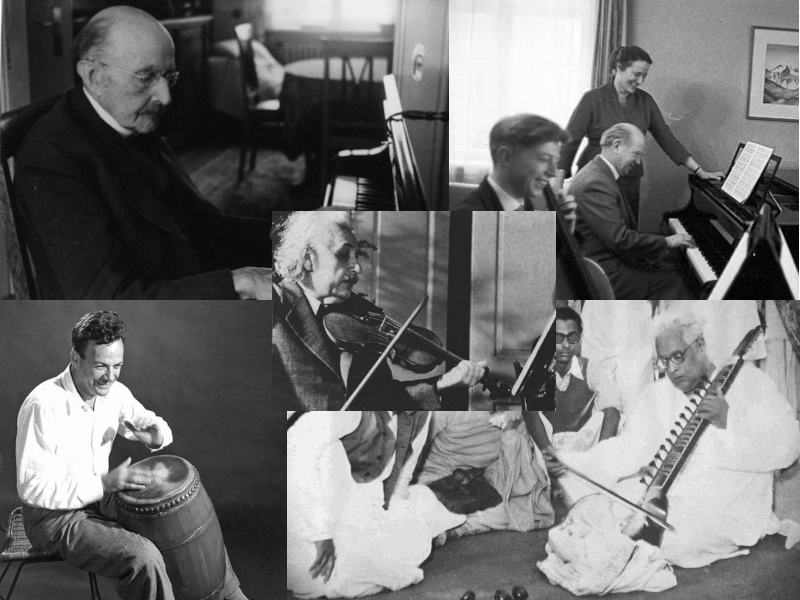
Physics and music are both important parts of my life, a combination I have also encountered in several physicists I know. More broadly, this overlap is not unusual: many renowned physicists have also been dedicated musicians, including Albert Einstein, an avid violinist; Max Planck and Werner Heisenberg, both accomplished pianists; Satyendra Nath Bose, who played the esraj; and Richard Feynman, known for his enthusiasm for the conga drums. On the other hand, examples of musicians with a strong background in physics, such as Brian May (guitarist of Queen, with a PhD in Astrophysics), show that the reverse is also possible. While it is not fully understood why physicists are drawn to music, this connection is not surprising. Both physics and music rely heavily on pattern recognition, mathematical structure, and abstract thinking.
The relation between physics and music also has deep historical roots. In ancient Greece, the natural philosopher Pythagoras found that the pitch of a musical note is inversely proportional to the length of the string that produces it, and that intervals between harmonious frequencies form simple numerical ratios. He further proposed that the proportions in the movements of celestial bodies produced the "music of the spheres".
Galileo's father, Vincenzo Galilei, a well-known lutenist, composer, and music theorist of his time, together with his young son, experimented with stretched lute strings, and contributed significantly to the understanding of the physics of vibrating strings. We should also mention Johannes Kepler. In his work Harmonice Mundi, inspired by Pythagoras, he tried to explain the proportions of the natural world in terms of music.
The modern connection between physics and music is based on the vibrating string equation, with important names, like d'Alembert, Euler, Bernoulli and Lagrange, contributing to its formulation and solution. Nowadays, physics and music cover a large range of subjects: from understanding musical sound, to physics of instruments, psychoacoustics and the design of music halls.
In this article, we will explore the fundamental question:
Is there a physical basis to music?
The short answer is yes. In the following, we begin with the physical quantity of frequency and demonstrate its connection to musical notes. Furthermore, we explore why some combinations of notes sound pleasing (consonant intervals) while others do not (dissonant intervals), leading us to major chords and the construction of the major scale.
The article presupposes some basic knowledge of mathematics and music theory. Readers without a background in music will find all the necessary concepts in the Appendix. Although some equations and formulas appear, they are explained in an intuitive way, and technical details are not required for understanding the text.
The Bibliography lists books that can help readers explore the subject in greater depth. Book [1] provides a good introduction for the non-expert, while [2-5] are suitable for readers with a background in physics and mathematics. Book [6] is a standard university textbook on vibrations and waves. For those interested in music theory and harmony, [7] is a good introductory text, while [8] is an older but classic work by the important composer and theorist Arnold Schoenberg.
2. Pitch, Frequency and Trigonometric Functions
What we call sound is a complex interweaving of individual tones. A musical tone typically consists of a fundamental component, the pitch, together with a series of overtones. Pitch is how we perceive what in physics we call frequency. Thus, frequency is an objective, measurable quantity, while pitch is the subjective way in which the human ear perceives it. In this section we will define frequency and we will hear how its pitch sounds. This discussion will also help us introduce, in an informal and intuitive way, the trigonometric functions sine and cosine, which will play an important role later when we discuss overtones.
To understand the concept of frequency, consider a small ball
moving around a circular ring at
a constant rate (or more precisely, with constant angular velocity),
as is depicted in the upper-left panel of the following animation:
Our ball performs what we call periodic motion: after a specific time interval, the so-called period, the ball passes through the same point on the ring. Frequency is defined as the number of circles the ball completes in one second. It is therefore measured in cycles per second, or Hertz (Hz).
Now, imagine that the ball starts at the rightmost point of the circle. Each time it passes through that point, a beep is produced. If the ball completes 5 cycles per second (that is, a frequency of $f=5Hz$), we hear a sequence of distinct beeps:
Let us return to our rotating ball and imagine attaching a pen to it. At the same time, we move a sheet of paper horizontally beneath the pen at a constant speed. The resulting motion is illustrated in the upper-right panel of the animation. As the ball rotates and the paper moves, the pen traces out a curve. This curve is what we call a sine wave, and in mathematics it is described by the function $y(t)=R \sin(2\pi f t)$, where $R$ is the amplitude (the radius of the circle) and $f$ is the frequency. In a similar way, we can obtain the cosine wave $y(t)=R \cos(2\pi f t)$. In this case, we have to roll the sheet of paper vertically. The result is illustrated in the lower-left panel of the animation.
3. The Vibrating String and the Harmonics
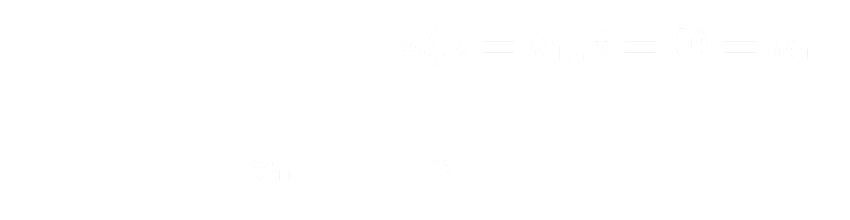 When the string is released, it begins to vibrate,
and its shape changes continuously over time.
To describe this motion mathematically, we introduce a function $u(x,t)$,
which represents the vertical displacement of the string at position $x$
and time $t$. In this way, the entire motion of the string is encoded in
a single function of two variables: one for space and one for time.
At the initial time $t=0$, the string has a certain shape determined
by how it was plucked. This initial shape provides an initial condition.
As time evolves, the function $u(x,t)$ changes according
to the physical laws governing the motion of the string, which we will formulate next.
To determine how $u(x,t)$ evolves over time, we must now translate the physical
properties of the string into mathematical terms. The key idea is that each small
segment of the string is subject to forces due to the tension in the string, which
tend to restore it to its equilibrium straight position,
(the horizontal dashed line in the above sketch).
If the displacements are small, the motion of the string can be well approximated
by a linear model. In this case, one can show (using Newton's laws of motion)
that the function $u(x,t)$ satisfies the wave equation [6]:
$$\frac{\partial^2 u(x,t)}{\partial t^2} = c^2 \frac{\partial^2 u(x,t)}{\partial x^2}$$
where $c$ represents the speed at which waves travel along the string.
It depends on the physical properties of the string, specifically its tension $T$ and
its mass per unit length $\rho$. This equation expresses a simple but powerful idea:
the acceleration of a point on the string (the left-hand side) is proportional
to how curved the string is at that point (the right-hand side).
Regions of high curvature experience stronger restoring forces,
causing them to accelerate more. To complete the mathematical model,
we must also specify boundary conditions. Since the string is fixed at both ends,
its displacement there is always zero:
$$u(0,t)=u(L,t)=0$$ for every time $t$. Together with the initial shape of the string
and its initial velocity, these conditions fully determine the motion of the string.
By solving the string equation [6] we find that
only certain special spatial patterns are allowed. Furthermore, at any
given time $t$ the solution can be written as an infinite sum of these different patterns,
each of them contributing with a different weight $C_n$. We can write it in the form:
When the string is released, it begins to vibrate,
and its shape changes continuously over time.
To describe this motion mathematically, we introduce a function $u(x,t)$,
which represents the vertical displacement of the string at position $x$
and time $t$. In this way, the entire motion of the string is encoded in
a single function of two variables: one for space and one for time.
At the initial time $t=0$, the string has a certain shape determined
by how it was plucked. This initial shape provides an initial condition.
As time evolves, the function $u(x,t)$ changes according
to the physical laws governing the motion of the string, which we will formulate next.
To determine how $u(x,t)$ evolves over time, we must now translate the physical
properties of the string into mathematical terms. The key idea is that each small
segment of the string is subject to forces due to the tension in the string, which
tend to restore it to its equilibrium straight position,
(the horizontal dashed line in the above sketch).
If the displacements are small, the motion of the string can be well approximated
by a linear model. In this case, one can show (using Newton's laws of motion)
that the function $u(x,t)$ satisfies the wave equation [6]:
$$\frac{\partial^2 u(x,t)}{\partial t^2} = c^2 \frac{\partial^2 u(x,t)}{\partial x^2}$$
where $c$ represents the speed at which waves travel along the string.
It depends on the physical properties of the string, specifically its tension $T$ and
its mass per unit length $\rho$. This equation expresses a simple but powerful idea:
the acceleration of a point on the string (the left-hand side) is proportional
to how curved the string is at that point (the right-hand side).
Regions of high curvature experience stronger restoring forces,
causing them to accelerate more. To complete the mathematical model,
we must also specify boundary conditions. Since the string is fixed at both ends,
its displacement there is always zero:
$$u(0,t)=u(L,t)=0$$ for every time $t$. Together with the initial shape of the string
and its initial velocity, these conditions fully determine the motion of the string.
By solving the string equation [6] we find that
only certain special spatial patterns are allowed. Furthermore, at any
given time $t$ the solution can be written as an infinite sum of these different patterns,
each of them contributing with a different weight $C_n$. We can write it in the form:
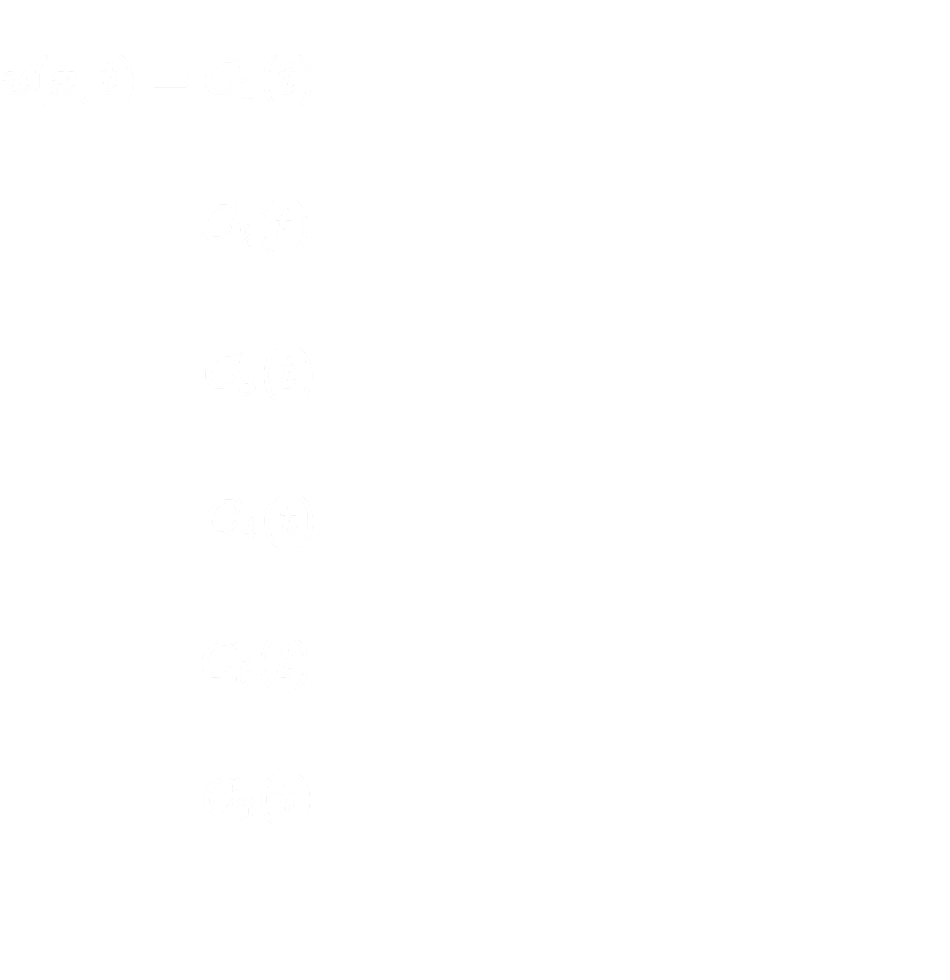 where in the parentheses we recognise the sine wave forms.
Indeed, the formal solution of the string equation is written:
$$u(x,t) = \sum_{n=1}^\infty C_{n}(t) \sin\left(\frac{n\pi}{L}x\right).$$
Here we must note that in practice, higher harmonics typically have smaller amplitudes,
so only the first few significantly affect the sound.
The spatial patterns are called normal modes of the string. Each mode corresponds
to a standing wave: the string vibrates in a fixed pattern, with nodes
(points that do not move) at the ends and at equally spaced positions along the string.
However, what we are looking for is hidden inside the coefficients:
$$C_n(t) = A_n \cos(2\pi f_n t) + B_n \sin(2\pi f_n t),$$
where the frequency is
$$f_n = \frac{n\pi}{L}\sqrt{\frac{T}{\rho}}.$$
First important observation is that each spatial pattern
has its own natural frequency $f_n$,
which depends on the physical characteristics of the string:
its length $L$, its tension $T$ and the density $\rho$ of the material that is made of.
The lowest frequency $f_1$ is called the fundamental frequency.
It determines the pitch we perceive when the string
is played. The higher frequencies,
$$f_2= 2f_1,~f_3 = 3f_1,~f_4 = 4f_1,~...$$
are called overtones or
harmonics. They are integer multiples of the fundamental
frequency and are always present, although with different strengths depending on
how the string is plucked.
This brings us to the second observation. The coefficients $A_n$ and $B_n$
depend on how the string was initially displaced and released. For example, plucking the string at
$x_0=3L/4$ excites some harmonics more strongly than others, which is why the tone
of the sound depends on where the string is plucked.
When we pluck the string above the sound hole the sound is more "warm",
while if we pluck near the saddle the sound is more "metallic".
The following animation summarizes our discussion.
In the upper panel we see the motion of the string if we pluck it at
$x_0=3L/4$. In this simulation we have used 20 harmonics.
In the lower-left panel we observe the
actual first three harmonics that contribute to the motion at each time instant.
Finally, in the lower-right panel we have how much each harmonic contributes.
where in the parentheses we recognise the sine wave forms.
Indeed, the formal solution of the string equation is written:
$$u(x,t) = \sum_{n=1}^\infty C_{n}(t) \sin\left(\frac{n\pi}{L}x\right).$$
Here we must note that in practice, higher harmonics typically have smaller amplitudes,
so only the first few significantly affect the sound.
The spatial patterns are called normal modes of the string. Each mode corresponds
to a standing wave: the string vibrates in a fixed pattern, with nodes
(points that do not move) at the ends and at equally spaced positions along the string.
However, what we are looking for is hidden inside the coefficients:
$$C_n(t) = A_n \cos(2\pi f_n t) + B_n \sin(2\pi f_n t),$$
where the frequency is
$$f_n = \frac{n\pi}{L}\sqrt{\frac{T}{\rho}}.$$
First important observation is that each spatial pattern
has its own natural frequency $f_n$,
which depends on the physical characteristics of the string:
its length $L$, its tension $T$ and the density $\rho$ of the material that is made of.
The lowest frequency $f_1$ is called the fundamental frequency.
It determines the pitch we perceive when the string
is played. The higher frequencies,
$$f_2= 2f_1,~f_3 = 3f_1,~f_4 = 4f_1,~...$$
are called overtones or
harmonics. They are integer multiples of the fundamental
frequency and are always present, although with different strengths depending on
how the string is plucked.
This brings us to the second observation. The coefficients $A_n$ and $B_n$
depend on how the string was initially displaced and released. For example, plucking the string at
$x_0=3L/4$ excites some harmonics more strongly than others, which is why the tone
of the sound depends on where the string is plucked.
When we pluck the string above the sound hole the sound is more "warm",
while if we pluck near the saddle the sound is more "metallic".
The following animation summarizes our discussion.
In the upper panel we see the motion of the string if we pluck it at
$x_0=3L/4$. In this simulation we have used 20 harmonics.
In the lower-left panel we observe the
actual first three harmonics that contribute to the motion at each time instant.
Finally, in the lower-right panel we have how much each harmonic contributes.
An interesting question is whether we can isolate individual harmonics. Guitarists do this using natural harmonics. For instance, lightly touching the string at its midpoint ($x=L/2$)—above the 12th fret—and then plucking it enforces a node at that point. As a result, only harmonics that already have a node there can survive. These are the even harmonics $n=2,4,6,...$ . Among them, the second harmonic is usually dominant, so the sound we hear is primarily that of $f_2$. A slow-motion video reveals these patterns visually: the string vibrates in distinct segments separated by a node (at $x=L/2$) that remains stationary.
 Similarly, to excite the third harmonic, one must touch the string at positions
corresponding to one-third or two-thirds of its length. On a guitar,
these locations lie close to the 7th and 19th frets. Although the frets do not
align perfectly with these fractional positions, they are close enough for the
harmonic to ring clearly.
Similarly, to excite the third harmonic, one must touch the string at positions
corresponding to one-third or two-thirds of its length. On a guitar,
these locations lie close to the 7th and 19th frets. Although the frets do not
align perfectly with these fractional positions, they are close enough for the
harmonic to ring clearly.
4. Timbre
In the previous section, we saw that plucking a string produces a fundamental tone and a series of overtones. But how are these related to musical notes? Suppose that we pluck the 5th string of a guitar, that is, we play the $A3$ note. In this case, the fundamental frequency is $f_1=220Hz$ and the overtones are $f_2=440Hz$, $f_3=660Hz$, $f_4=880Hz$, $f_5=1100Hz$, and so on. These correspond approximately (though not exactly, due to tuning differences) to the fundamental frequencies of the notes $A4$, $E5$, $A5$, $C\# 6$, etc., respectively. Thus, a single plucked string already contains multiple pitches embedded within it.

If only the presence of these frequencies determined the sound of a note, then all stringed instruments would sound the same. Of course, this is not true: every musical instrument has its own "sound color" or timbre. In reality, timbre depends not only on which harmonics are present, but also on their relative amplitudes and how they evolve in time.
The example of the guitar is enlightening. The sound of a string alone is very weak, so every instrument needs a mechanism to amplify it. In the case of the guitar, this occurs in its hollow body. The vibrating string transfers its energy through the bridge to the soundboard (the thin wooden top of the guitar). The soundboard has a large surface area compared to the string, so it vibrates much more air, dramatically increasing the sound volume.
The hollow body of the guitar acts as a resonating chamber. The air inside vibrates along with the soundboard, and certain frequencies are reinforced due to resonance. The back and sides of the guitar reflect and shape the sound. They do not amplify it as much as the top, but they influence tone, sustain, and projection. Finally, the sound hole helps project the sound outward.
This complex process shapes the harmonics, and gives the instrument its characteristic timbre. The wood of the soundboard and the construction techniques therefore play an important role in determining the timbre, because they affect how the soundboard vibrates and how the harmonics are distributed. This is why guitars made by different luthiers can sound so different.
5. Chords and the Major Scales
- Harmonics 1, 2, 4, ... are all $A$'s in higher octaves.
- Harmonics 3, 6, ... give $E$ (a perfect fifth).
- Harmonic 5 gives $C \#$ (a major third).
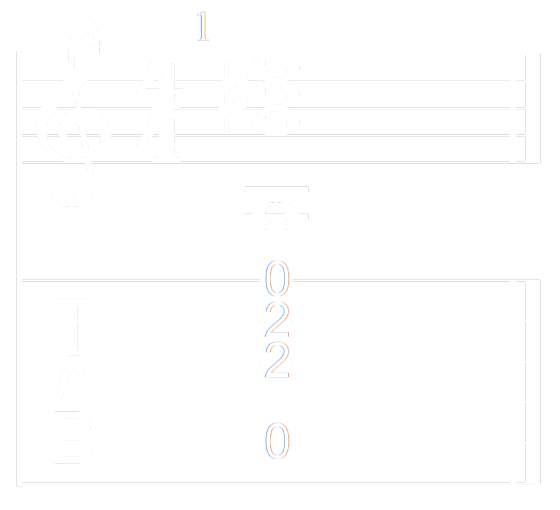
From this, we can understand why intervals such as the perfect fifth (e.g., $A$-$E$) sound "pleasant": the harmonic series of the fundamental note already contains the second note of the interval. A similar relationship holds for the major third (e.g., $A$-$C\#$) and the major sixth. These intervals are called consonant. In musical practice, the minor third and minor sixth are also considered consonant, although they are not as directly represented among the lowest harmonics. Other intervals are generally described as dissonant, meaning that they create a sense of tension that often resolves to consonant intervals. If we play the three notes $A$, $C\#$ and $E$ together, the resulting sound is stable and pleasing. A musician recognizes this combination as the $A$ major chord:
 Chords are the pillars of musical compositions, providing the harmonic structure
upon which melodies and rhythms rest. Major chords, such as $A$ major, often convey a
sense of brightness and stability, making them an essential ingredient in many musical
styles. How we connect chords to create a coherent musical piece is the subject of
harmony [7,8].
If chords are the pillars of a composition, then scales are the foundations upon which
those chords are built. Next, following Schoenberg [8],
we will construct the major scale using the elements we have already introduced.
Let us begin with the note $C$ and consider its harmonic series. A perfect fifth
above $C$ is $G$, while a perfect fifth below $C$ is $F$. If we also consider the harmonic
series of these related notes, we obtain a collection of closely connected pitches.
Chords are the pillars of musical compositions, providing the harmonic structure
upon which melodies and rhythms rest. Major chords, such as $A$ major, often convey a
sense of brightness and stability, making them an essential ingredient in many musical
styles. How we connect chords to create a coherent musical piece is the subject of
harmony [7,8].
If chords are the pillars of a composition, then scales are the foundations upon which
those chords are built. Next, following Schoenberg [8],
we will construct the major scale using the elements we have already introduced.
Let us begin with the note $C$ and consider its harmonic series. A perfect fifth
above $C$ is $G$, while a perfect fifth below $C$ is $F$. If we also consider the harmonic
series of these related notes, we obtain a collection of closely connected pitches.
 By combining these pitches, removing repetitions, and arranging them in order,
we arrive at the seven notes of the major scale in Western music:
$C$, $D$, $E$, $F$, $G$, $A$, $B$.
Examining the frequency relationships between these notes, we find that the intervals
$E$-$F$ and $B$-$C$ are smaller than the others; they are semitones,
whereas the remaining adjacent intervals are whole tones.
This interval pattern defines every major scale (see Appendix).
The $C$ major scale is unique in that it consists only of natural notes,
without accidentals. By applying the same process starting from any other note,
we can construct all the major scales used in Western music, which generally
include accidentals.
Notably, to construct the $C$ major scale we used just three key notes:
$C$ (the tonic), $F$ (the subdominant), and $G$ (the dominant). The importance of these
notes is reflected in the fact that one of the first things a student of harmony
learns is that chords built on them are the easiest to connect and are fundamental
for writing well-balanced chord progressions.
By combining these pitches, removing repetitions, and arranging them in order,
we arrive at the seven notes of the major scale in Western music:
$C$, $D$, $E$, $F$, $G$, $A$, $B$.
Examining the frequency relationships between these notes, we find that the intervals
$E$-$F$ and $B$-$C$ are smaller than the others; they are semitones,
whereas the remaining adjacent intervals are whole tones.
This interval pattern defines every major scale (see Appendix).
The $C$ major scale is unique in that it consists only of natural notes,
without accidentals. By applying the same process starting from any other note,
we can construct all the major scales used in Western music, which generally
include accidentals.
Notably, to construct the $C$ major scale we used just three key notes:
$C$ (the tonic), $F$ (the subdominant), and $G$ (the dominant). The importance of these
notes is reflected in the fact that one of the first things a student of harmony
learns is that chords built on them are the easiest to connect and are fundamental
for writing well-balanced chord progressions.
6. Outro
Appendix: Elements of Music Theory
 When a note is followed by a number, this indicates the octave to which it belongs.
For example, $A3$ denotes the $A$ in the third octave of the piano, with a frequency
of approximately $220Hz$.
Intervals
An interval is the distance between two notes. Two particularly important intervals are:
When a note is followed by a number, this indicates the octave to which it belongs.
For example, $A3$ denotes the $A$ in the third octave of the piano, with a frequency
of approximately $220Hz$.
Intervals
An interval is the distance between two notes. Two particularly important intervals are:
- Perfect Fifth. This interval spans seven semitones (for example: $C$-$G$). It is called "perfect" because of its strong stability and its prominent appearance in the harmonic series.
- Major Third. This interval spans four semitones (for example: $C$-$E$) It plays a crucial role in determining whether a chord is major.
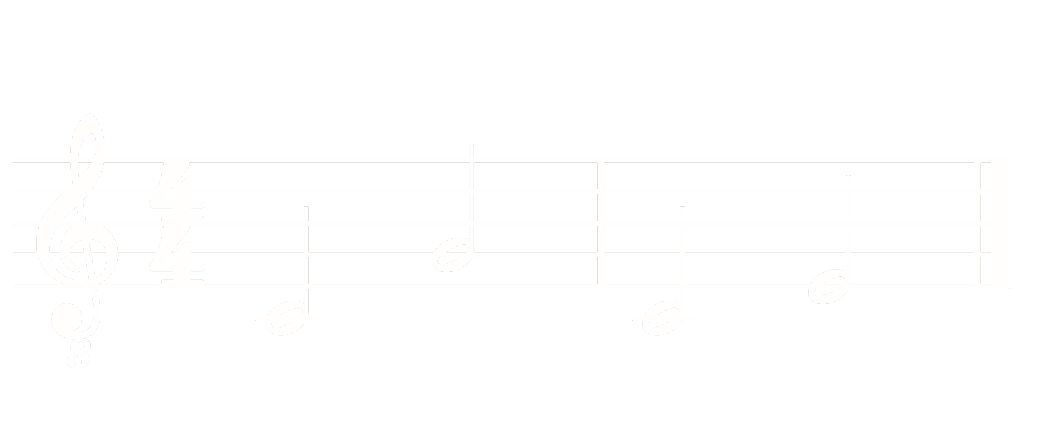 Intervals are often described as:
- Consonant: stable and harmonious (e.g., perfect fifth, major third).
- Dissonant: more tense and unstable, often requiring resolution.
- The root (starting note).
- A major third above the root.
- A perfect fifth above the root.
 The Major Scale
A scale is an ordered sequence of notes. The major scale is one of
the most important scales in Western music. It consists of seven
notes arranged in a specific pattern of whole tones (W)
and semitones (S):
The Major Scale
A scale is an ordered sequence of notes. The major scale is one of
the most important scales in Western music. It consists of seven
notes arranged in a specific pattern of whole tones (W)
and semitones (S):
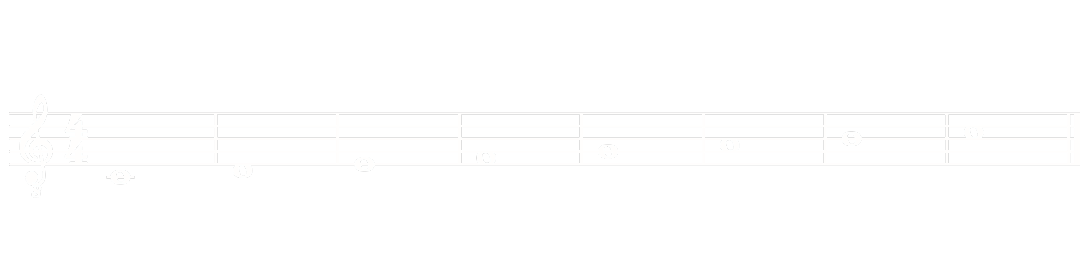 The $C$ major scale is unique because it uses only natural notes (no sharps or flats).
Bibliography
[1] Music by the Numbers
E. Maor, Princeton University Press 2018.
[2] Physics and Music
K. Tsuji and S.C. Müller, Springer 2021.
[3] Musimathics, Vol. 1 & 2
G. Loy , The M.I.T. Press 2006.
[4] The Physics of Music and Color
L. Gunther, Springer 2012.
[5] Tunning, Timber, Spectrum, Scale
W. Sethares, Springer 2005.
[6] Vibrations and Waves
A.P. French , CRC Press 2001.
[7] Tonal Harmony with introduction to post-tonal music
S. Kostka, D. Payne, B. Almén , 8th edition, MacGraw-Hill 2018.
[8] Theory of Harmony
A. Schoenberg, Univesity of California Press 1983.